NGC 1850: An Intriguing Double Star Cluster
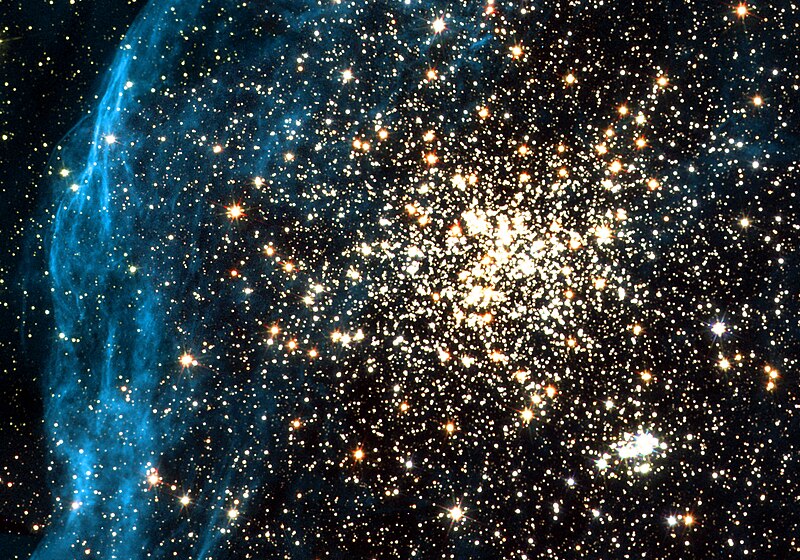
Exploring NGC 1850 unveils a celestial marvel, contrasting beauty with mystery. This young massive double star cluster nestled within the Large Magellanic Cloud, captivates astronomers with its vibrant star clusters and enigmatic origins.
Double Star Cluster
NGC 1850, discovered by Scottish astronomer James Dunlop in 1826, stands out for its unique characteristics as a double star cluster. The main cluster is older than the smaller one. As a result, it showcases an intriguing age difference.
The primary cluster in NGC 1850 boasts a remarkable age of around 50 million years. The secondary cluster is notably younger at approximately 4.3 million years. This stark contrast in ages between the two clusters within NGC 1850 provides valuable insights into stellar evolution and formation processes.
NGC 1850 is also considered a rare young globular-like cluster. This means it shares structural similarities with ancient globular clusters despite being relatively young. Studying such objects helps astronomers better understand how massive star clusters may have formed and evolved in the early universe.
Stellar Formation Significance
NGC 1850 plays a crucial role in advancing our understanding of star formation and stellar mass scales. The distinct ages of the clusters offer astronomers a rare opportunity. Because of this, they can study how stars evolve over time within a single region.
The younger component contains hot, massive stars and young stellar objects, while the older cluster provides a glimpse into later stages of stellar evolution. Together, they serve as a natural laboratory. This helps with studying how stars form, age, and interact within dense stellar environments.
Location and Dimensions
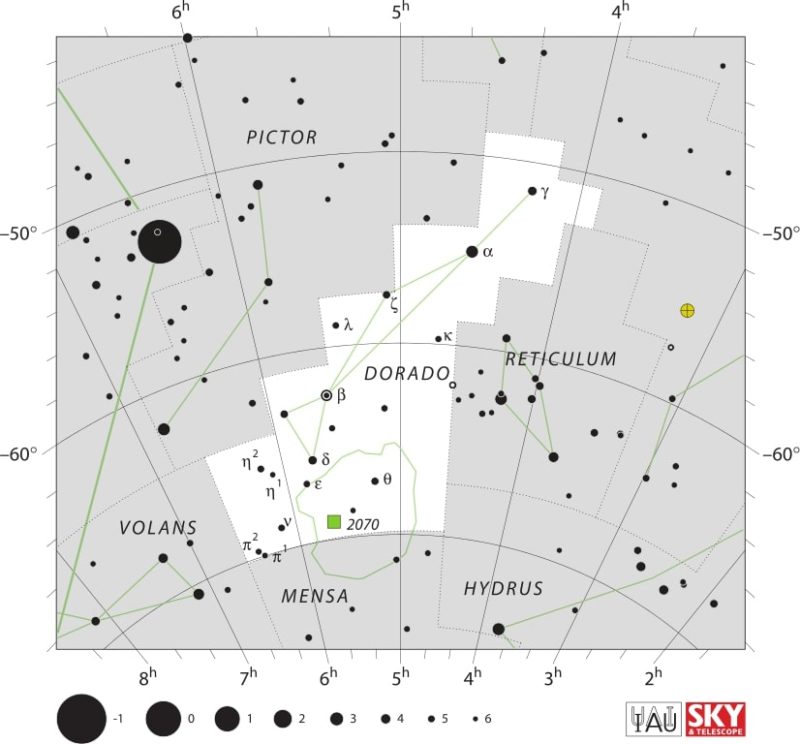
Situated in the Dorado constellation, NGC 1850 holds a prominent spot in the night sky. Its dimensions span 16.2 light-years. This reveals the grandeur of this celestial entity.
It is located approximately 163,000 light-years away in the northwest part of the bar of the Large Magellanic Cloud. The Large Magellanic Cloud is a satellite dwarf galaxy of the Milky Way.
NGC 1850 is surrounded by glowing gas and dust that have been shaped by powerful stellar winds and past supernova explosions from massive stars. These features contribute to the cluster’s striking appearance. Moreover, they provide clues about its dynamic history.
NGC 1850 is often compared to its nearby neighbor NGC 1856, another double cluster in the LMC. However, NGC 1850’s striking age contrast makes it particularly valuable for studying stellar evolution. Amateur astronomers with medium telescopes in the Southern Hemisphere can observe this cluster, though it is too faint for the naked eye. With an apparent magnitude of about 9, it is best viewed as part of the rich star fields of the Large Magellanic Cloud.
Closing Thoughts
You’ve delved into the fascinating world of NGC 1850, uncovering its mysteries and significance in the vast cosmos. The key features have provided you with a deeper understanding of this remarkable star cluster.
Take your newfound knowledge and continue to explore the wonders of space. Whether through stargazing, further research, or sharing your passion with others, let the marvels of NGC 1850 inspire you to keep seeking knowledge about the universe around us.
Would you like to receive similar articles by email?

Paul Tomaszewski
Paul Tomaszewski is a science & tech writer as well as a programmer and entrepreneur. He is the founder and editor-in-chief of CosmoBC. He has a degree in computer science from John Abbott College, a bachelor's degree in technology from the Memorial University of Newfoundland, and completed some business and economics classes at Concordia University in Montreal. While in college he was the vice-president of the Astronomy Club. In his spare time he is an amateur astronomer and enjoys reading or watching science-fiction. You can follow him on LinkedIn and Twitter.

You May Also Like
Why Your Kids Will Live on Mars
Stargazing Calendar for May 2026